
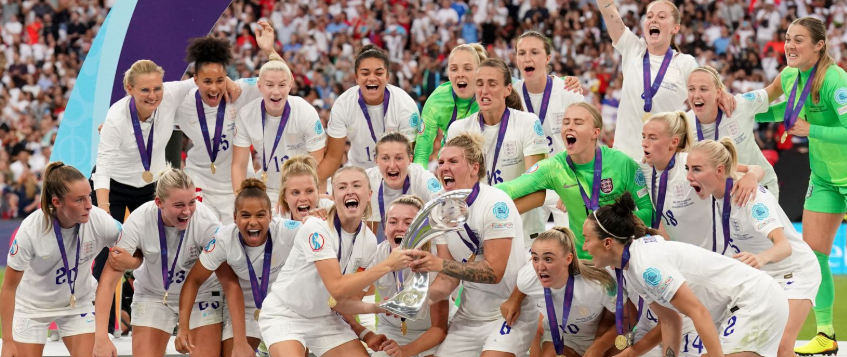
The Lionesses Effect: How Women’s Football Is Changing England
England’s European champions have done more than win trophies. They have challenged old assumptions about who belongs on the pitch. Now comes the harder task: turning a national celebration into lasting social change.
In England, football has traditionally been more than a sport. It is a language of identity, a source of community pride and, for generations, a defining part of popular culture. But for much of its history, that culture offered women a place on the sidelines rather than at the center of the game.
The Lionesses are changing that story.
England’s women’s national team captured the UEFA Women’s European Championship in 2022, winning the country’s first major senior international football title in decades. Three years later, the team defended its crown at Euro 2025 in Switzerland, defeating Spain in a dramatic penalty shootout. England had become European champions again, this time winning a major tournament abroad for the first time in the history of its senior national teams.
Yet the most important measure of the Lionesses’ success may not be the trophies in their cabinet. It may be the number of girls who now see a football pitch and imagine themselves on it.
A victory that changes who believes they belong
The impact of elite athletes often extends far beyond the competition itself. When a team becomes a national symbol, its players can change perceptions about what is possible, who deserves recognition and which ambitions society considers legitimate.
The Lionesses have become powerful examples of that influence. Their performances have helped make women’s football more visible in homes, schools, stadiums and the media. Players who were once relatively unknown outside dedicated sporting circles have become recognizable public figures, demonstrating that women’s football can generate excitement, commercial interest and national pride.
The numbers offer evidence of this cultural shift. Following England’s 2025 European triumph, searches for opportunities to play women’s and girls’ football increased by 196% in a single day. Five months after the tournament, participation had risen by 5% compared with levels before the competition. The Football Association also reported year-on-year increases of 12% in female coaches and 29% in female referees.
These developments matter because participation creates possibilities that visibility alone cannot provide. A girl who joins a local team gains more than an opportunity to improve her technique. She can develop confidence, learn to collaborate, experience healthy competition and discover the satisfaction of pursuing a demanding goal.
The transformation also challenges a persistent cultural assumption: that football is naturally a man’s game. Talent has never belonged to one gender. What has differed historically is access to facilities, investment, media exposure and institutional support.
England’s history makes that distinction particularly significant. In 1921, the Football Association prohibited affiliated clubs from allowing women’s football on their grounds, effectively restricting the game for decades. The ban was lifted in 1971. The modern success of the Lionesses therefore represents not simply sporting progress, but movement away from a long institutional history of exclusion.
The real test begins after the celebrations
There is, however, a danger in assuming that winning a championship automatically transforms an entire sporting culture.
Major tournaments produce powerful emotional moments. Television audiences rise, public attention intensifies and young fans discover new sporting heroes. But attention can fade when the tournament ends, particularly if domestic competitions struggle to maintain visibility.
Recent developments in England illustrate both the progress and the challenge. In September 2026, the Football Association reported a 15% increase in female football participation across its grassroots game, reaching 255,000 players. It also reported that 90% of schools now provide girls with equal access to football through physical education at the relevant school stages.
These are meaningful advances, but access on paper does not always mean equal opportunity in practice. Girls still need safe playing spaces, qualified coaches, suitable facilities and encouragement to continue playing as they grow older.
There are also cultural barriers. In October 2026, the FA’s director of women’s football, Sue Day, highlighted misogyny and social pressures as continuing obstacles to girls’ participation. The challenge, therefore, is not only to provide more pitches. It is to create environments in which girls can use them without feeling that their ambitions require justification.
The distinction is important. A society can celebrate female athletes on television while still discouraging girls from pursuing sport in their own communities. It can applaud a winning team without questioning the everyday attitudes that limit opportunities for the next generation.
Changing that contradiction requires sustained investment, responsible coaching, meaningful school programs and media coverage that extends beyond major tournaments. It also requires clubs to build relationships with local communities rather than relying exclusively on the popularity of national-team stars.
A different definition of sporting legacy
The Lionesses offer a broader lesson about the relationship between sporting excellence and social progress. Success can open doors, but institutions must keep them open.
For sponsors, the women’s game represents an opportunity to invest in an audience whose enthusiasm continues to develop. For schools and local authorities, it offers a reason to strengthen participation programs. For clubs, it creates an opportunity to build a more inclusive sporting culture. For families, it provides visible examples of women competing at the highest level without having to apologize for their ambition.
The greatest legacy would be a future in which girls do not need a European championship to convince others that they deserve a place on the pitch. They would simply expect that place to be available.
That is also why the Lionesses’ influence should not be measured exclusively through ticket sales, television ratings or merchandise. Those indicators reveal commercial momentum, but they cannot fully capture the value of a child who discovers confidence through sport, a community that becomes more inclusive or a young player who continues competing because she finally sees a future for herself.
England’s women have already demonstrated that they can win at the highest level. Their next achievement may be less visible but even more consequential: helping ensure that talent, rather than gender or circumstance, determines who gets the chance to play.
The scoreboard records the champions. The real legacy will be written by the generations who follow them.