

Leadership: The Multiplier Effect What We Do at Work Never Stays at Work
Leadership can change people’s lives. I mean it quite literally. Leaders influence who receives an opportunity, whose ideas are heard, how mistakes are treated, what behaviors are rewarded, and whether people feel trusted enough to exercise their own judgment. We can help someone discover capabilities they did not know they
possessed or create an environment in which a highly capable person gradually stops trusting themselves. Those effects do not disappear when the workday ends.
Confidence goes home, along with anxiety or pride. So does the feeling that nothing you do is quite right because no one has made clear what “right” looks like. I have seen exceptional talent unleashed by leaders willing to simplify what others had unnecessarily complicated, and I have watched equally talented people become trapped beneath organizational noise, competing agendas, delayed decisions, and
conversations that should have happened months earlier.
For much of my career, I was paid to think about results: growth, customer experience, strategy, transformation, speed, execution. I still care about all of them, but experience has made me equally interested in another measure of leadership: What happens to the people responsible for producing those results because of the way we lead them? That question changed the way I thought about leadership itself. Earlier in my career, I believed successful leaders distinguished themselves by having better answers.
Experience taught me something more valuable. The strongest leaders are not necessarily those who know the most; they are often the ones who see most clearly.
Leadership is fundamentally an exercise in judgment, and judgment becomes consequential because every decision made at the top travels.
That is why I believe the impact of leadership extends far beyond the decisions we make. We establish, often without realizing the full extent of it, the conditions under which other people work. We signal whether disagreement is safe, whether mistakes become opportunities to learn or reasons to conceal the next one, and whether good judgment will be trusted or every meaningful decision must eventually travel upward.
Clarity: Questions Leadership Should Answer
One of the simplest questions I ask executives is also one of the most revealing: What are you trying to accomplish? Leaders arrive ready to discuss communication, culture, organizational design, slowing growth, succession, or a difficult personality. Often, what initially appears to be the problem is only part of the story. Once we stop discussing all the activity surrounding it and define the outcome we are trying to produce, we begin to
see where people are operating from different assumptions, and a different conversation begins. The same thing happens across organizations. A leadership team can be filled with intelligent, experienced people working hard while holding different views about what matters most at a particular moment. Growth, margin, retention, and
customer experience may all be important; leadership rarely has the luxury of choosing only one. The challenge is determining how those objectives should be prioritized when they compete for the same resources, attention, or decision. Clarity teaches people how to navigate competing priorities.
When leaders fail to make those choices, employees must interpret them. Which priority is really the priority? Whose direction takes precedence? Do I have authority to decide?
Will leadership support me if I get it wrong? People respond by scheduling another meeting, preparing another analysis, or seeking another approval. People can work extraordinarily hard when they understand why the work matters and can see that their effort is moving something important forward. What becomes exhausting? Interpreting an environment leadership has left unresolved.
I have always been something of a “cycle-time enthusiast.” During one period of my operating career, we examined a customer approval process that took weeks. By the time some prospective customers received an answer, they had lost interest, gone elsewhere, or begun their relationship with us frustrated. The process contained a series of individually reasonable approvals, reviews, and handoffs that collectively produced an unreasonable customer experience. We went to the people closest to the work and asked how they would change it. They knew! We substantially shortened the approval cycle, improved the customer experience from the outset, and reduced early customer attrition. That experience reinforced something I have seen repeatedly:
organizations often respond to disappointing performance by adding more analysis, meetings, initiatives, reporting, and oversight. Yet some of the most valuable leadership decisions are acts of subtraction: deciding which project no longer deserves resources, which approval adds no value, which opportunity must wait, and what the organization needs to stop.
Every priority consumes attention, capital, talent, and managerial energy. Leadership requires continually optimizing among priorities: understanding what matters most in this moment, what can wait, and where a tradeoff will produce the greatest return. Clarity pinpoints what deserves greater attention now, what can wait, and what the organization should stop doing altogether. Counterintuitively, this gives people more freedom. When capable people understand the outcome, the boundaries, and the principles that should govern decisions, they do not need to return to the leader for every next move.
Candor: Truth Leadership Cannot Avoid
Seeing reality clearly has limited value if we are unwilling to communicate honestly about what we see. Candor may be confused with bluntness, but I believe it has a much higher purpose. It should help another person grow, strengthen a relationship, improve a decision, resolve a problem, or move an organization forward. If it accomplishes none of those things, it may be honest, but it is not particularly useful.
Before a difficult conversation, I have learned to ask myself why I am being candid. If my objective is to prove that I am right or demonstrate my frustration, silence may be the better choice. If the purpose is to give someone information they need to improve or surface a truth the organization needs in order to make a better decision, candor becomes an act of leadership.
Avoiding a necessary conversation may feel kinder in the moment, but often it transfers the consequences. A performance issue left unaddressed becomes additional work for colleagues. A behavior tolerated from one senior executive becomes evidence of what the organization actually values. Silence communicates too. This becomes more consequential as we rise. People study our reactions. They notice which questions make us defensive and what happens to someone who disagrees. Experience is enormously valuable, but success can also make an assumption feel like fact. The strongest leaders I have known had enough confidence to make difficult decisions and enough humility to challenge their own conclusions.
Across industries, organizations, and cultures, I have found that people want many of the same things from their leaders. People want to understand what matters and what is expected of them. They want their judgment respected. They want to know that difficult truths can be spoken and heard, and they want to believe that the person entrusted with authority understands that authority carries responsibility. We should ask what
happened to the business while we were leading it. Did it grow? Did customers benefit?
Did we make better decisions and execute well? But I believe we should ask another set of questions with equal seriousness. What happened to the people? Did talented people become more capable around us? Did they gain confidence in their judgment? Did we create opportunity? Did our strongest people leave better equipped to lead others?
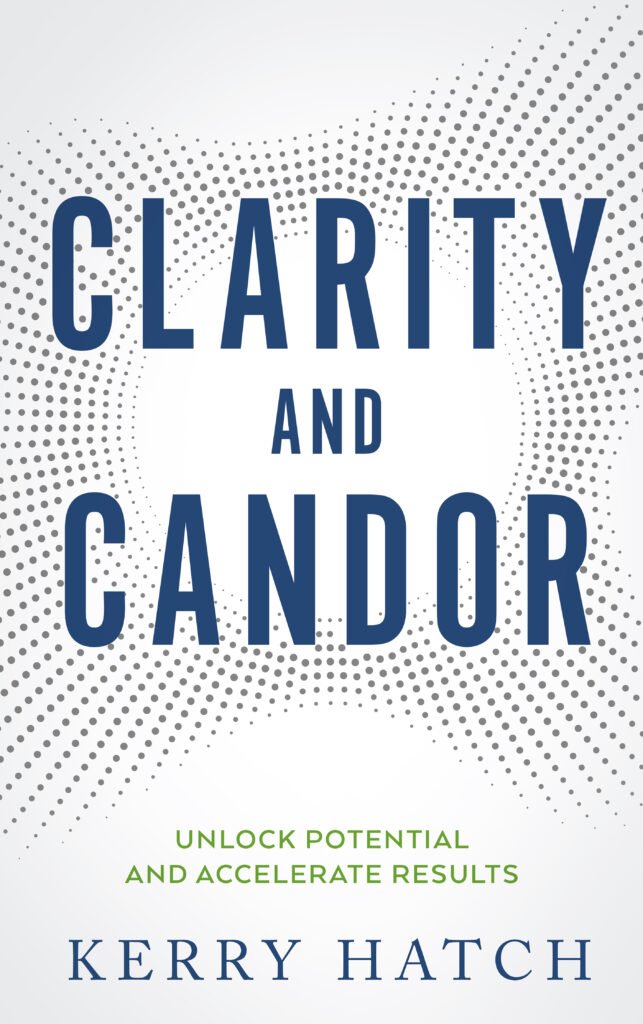
At its most formidable, leadership enlarges what is possible for other people. What a privilege. Kerry Hatch is a global executive, board director, investor, and executive coach with more than three decades of experience leading businesses, transformations, and senior teams. Her forthcoming book, Clarity and Candor: Unlock Potential and Accelerate Results, examines how leaders can make better decisions, unlock potential, and
accelerate results.
By Kerry Hatch