
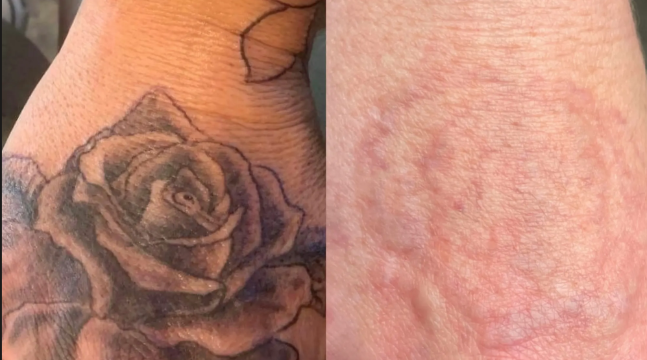
The Un-Tattoo Movement: Why More People Are Choosing to Erase Their Ink
For years, tattoos were celebrated as permanent declarations of identity. They represented rebellion, romance, freedom, personal milestones, and the courage to stand apart. Now, a growing number of people are making a different statement: they want their skin back.
From celebrities revealing dramatically tattoo-free appearances to ordinary people documenting laser-removal sessions on social media, tattoo removal is becoming an increasingly visible cultural trend. Sometimes described as the “untattoo” movement, it reflects a broader shift in how people think about permanence, personal identity, and the choices they make about their bodies.
The irony is hard to miss. A generation that embraced tattoos as an expression of individuality is discovering that individuality can also mean deciding to let them go.
When the person changes, the tattoo stays
A tattoo often tells the story of a particular moment in someone’s life. It might commemorate a relationship, represent a personal struggle, honor a loved one, or symbolize a belief that once felt unshakable.
But people change. Relationships end, careers evolve, priorities shift, and the person we become at 40 may have little in common with the person we were at 19.
A design that once felt deeply meaningful can eventually feel unfamiliar. A name that once represented forever may become an unwanted reminder of the past. Even a tattoo chosen simply because it looked fashionable can lose its appeal when the trend moves on.
For some people, removal is not an admission of failure. It is a declaration that the past does not have to dictate the present.
That distinction is important. Choosing to remove a tattoo does not necessarily mean regretting the person one used to be. It may simply mean recognizing that personal history does not need to remain permanently displayed on the skin.
From rebellion to regret?
Tattoos have traveled a remarkable cultural distance. Once associated in many societies with outsiders, sailors, subcultures, and rebellion against convention, they became increasingly visible in mainstream fashion, entertainment, and professional life.
As tattoos became more socially accepted, more people began experimenting with them. Yet normalization also changed their meaning. What was once a bold declaration of difference could become another popular aesthetic choice.
Now, some tattoo enthusiasts are reconsidering extensive body art, particularly designs acquired impulsively or during earlier stages of adulthood. Tattoo-removal specialists have reported seeing clients who want to eliminate old designs, simplify their appearance, or move away from an image that no longer reflects who they are.
Social media has helped make this reversal more visible. People share before-and-after photographs, discuss the cost of treatments, and document the long process of fading ink. The same digital culture that can encourage people to follow a trend can also expose them to the experiences of those who have decided to reverse it.
Still, it would be premature to conclude that tattoos themselves are disappearing. Many people continue to value their body art, and removal is a personal choice rather than a universal rejection of tattoo culture.
The more interesting development is the growing acceptance of changing one’s mind.
The price of changing your mind
Removing a tattoo is considerably more complicated than getting one.
Laser treatments work by targeting tattoo pigments and breaking them into smaller particles that the body can gradually clear. Depending on the tattoo’s size, colors, depth, location, and the individual’s skin characteristics, removal may require numerous sessions spread over months or even years.
The process can be painful and expensive, and complete removal is not always possible. Temporary changes in pigmentation, scarring, and other complications can occur, making professional assessment and appropriate medical supervision important.
In other words, permanence has a price—and reversing it can have one, too.
This reality offers a practical lesson for anyone considering a tattoo: the most important decision may not be choosing the design, but understanding the commitment before making it.
Could tattoos one day become reversible?
Perhaps the most intriguing development in this field comes from science.
In October 2026, reporting highlighted experimental photosensitive tattoo ink developed by nanoscientist Carson Bruns and collaborators at the University of Colorado Boulder. Known as PhotoTat, the technology is designed to change visibility in response to different wavelengths of light, potentially allowing a tattoo to become visible or nearly disappear under particular lighting conditions.
The concept challenges one of the defining characteristics of traditional tattooing: permanence.
Imagine a tattoo that could be visible at a music festival but concealed for a professional meeting, or a medical marking that could be made less visible when no longer needed. Such possibilities could eventually expand the purposes of tattooing beyond permanent decoration.
However, this technology remains experimental. It is not yet an established, widely available substitute for conventional tattoo ink, and further safety testing and development are necessary. It should not be confused with an ordinary tattoo that can already be removed at will.
Even so, the research points toward a fascinating possibility: future body art may offer more flexibility than the tattoos of previous generations.
What the movement really says about identity
Perhaps the most significant aspect of the untattoo trend has little to do with lasers or fashion.
It reflects a cultural shift in how people understand identity. For a long time, permanence was often treated as proof of authenticity: if something mattered, the thinking went, it deserved to last forever.
But human identity is rarely so fixed.
We change our minds about careers, relationships, beliefs, appearance, and the lives we want to lead. We abandon habits, revise ambitions, and discover that what once defined us no longer does. The ability to reconsider a decision can be a sign of maturity rather than inconsistency.
The same principle applies to body art. Keeping a tattoo can be an expression of self-confidence. Removing one can be equally so. Neither choice automatically says anything definitive about a person’s character.
The important thing is the freedom to choose without shame or pressure.
A new definition of permanence
The rise of tattoo removal does not necessarily signal the end of tattoo culture. Instead, it may mark the beginning of a more flexible relationship with personal expression—one that acknowledges both the desire to make a lasting statement and the reality that people evolve.
Perhaps the real cultural change is not that people want fewer tattoos. It is that they increasingly want ownership over what their appearance communicates, even when that means reconsidering a decision made years earlier.
A tattoo can preserve a memory, celebrate a chapter, or symbolize a belief. But it does not have to become a lifelong obligation simply because it was intended to be permanent.
After all, the most authentic expression of identity may not be the image we choose to keep forever, but the freedom to decide what still represents us.
Sometimes, moving forward means adding something to our story. Sometimes, it means having the courage to erase a line.